Hinduism,Hindus,BJP/RSS media, academia,politics; Whose fault is it anyway?

Interactions regarding this, with power being in hands of west to a larger degree has been the way over last few centuries, this has given a misplaced view among some Hindus that everyone are out to get them. There is some truth considering the influence of monotheism in culture in general and the fact that monotheism is bigotry. There are of course investments of various kinds, whether it be missionaries or left intellectuals, in India or outside whose nature of works is subversive at various times and not merely academic. This however is not to be seen in isolation that some of the best intellectuals, writers, actors ,philosophers have historically found positive interest in Hinduism . Julia roberts, russell brand among recent celebrities, Aldous Huxley infact wrote an introduction to Bhagvad Gita .George Harrison, one quarter of the famous “beatles” also found inspiration in Hinduism. Among scientists, Oppenheimer too was impressed by Bhagvad Gita and his choice of words are now immortalized in cultural memory. Schrodinger was another great physicist who also did find inspiration from ideas with in Hinduism.Among Philosophers, Schopenhauer stands tall, he too did find something of value in the writings of Upanishads.

So, it is not true to say this relationship was entirely negative. What is true is that it takes effort to build on the positive interactions and continue to keep building over that. And this effort must most certainly come from Hindus themselves and must be independent of politics through community effort. It is here that Hindus are found wanting. They have neglected humanities dept entirely and are now complaining of inherent malice.

They have not connected to the wider society through charity, education, tradition,literature & arts as other communities have done. It is also true that respect comes with power and wealth and India being poor compared to Japan or china had to face this. However here too they have no one else to blame but themselves for not distinguishing themselves economically from the left and make a reasoned argument for capitalism, distinguish themselves by standing for free speech and throw out rules engineered by congress govt under Nehru that bar free speech. By staying out of Humanities , they have allowed others to define them and have allowed the trajectory of Indian economy to be run by the left.This exacerbated poverty and all the faultlines in society . Even now, they cannot seem to make a case for why capitalism is better.When it is the greatest system for creation of wealth and helps mend faultlines and strengthen sovereignty .Nor do they seem to have a plan on how to mend the faultlines. To give an example, BJP govt has been in power in many states for well over 15 yrs, has been in power at the center for past 4 yrs, they have chosen not to give themselves autonomy over education in states where Hindus are minority nor have they spent much time over many decades to actually create avenues to rectify this lacunae by building institutions of learning and help them to mend the faultines in society tearing them apart or have regular events or meetings to bridge over faultlines. To even posit a future goal or trajectory requires a respect for intelligence which is not found in BJP/RSS but more importantly, there is no accountability asked by supporters of them either or by Hindus in general of all their leaders. The contempt for intellectuals is incredible and a good example of it is the Prime Minister India Narendra Modi declaring that “Hardwork is more powerful than Harvard”.This during the infamous demonetization which was carried out haphazardly & whose effects are being felt by citizens even now in form of cash crunch in various cities.

In general, it is those in power who can and should reach out to others, win over others. Come up with a more inclusive engagement with other communities, build trust and cultivate media relations that reflects this change. It instead seems as though a more cynical ploy is at play of allowing others to malign in hopes this will feed into anxiety of their supporters and unthinkingly get them to double down their loyalty and support them even further and carry forward this dynamic of tribalism that has helped them. To me atleast, it seems clear that for the BJP/RSS, they would rather have an electorate that never holds them accountable to anything and drive the anxiety of Hindus in general as it is politically useful to them. This is substantiated by the fact that they have no plan to ameliorate or redress any actual grievances. Nor transmute this anxiety by doing something constructive , whether it be in form of media ,literature, academia or any thing else. This leaves their supporters trapped.Which seems to be their only goal.

For Hindus in general, they need to ask themselves the hard question as to whether it is fair to ask others to stand up for them when they themselves chose not to do so for each other or hold their leaders accountable and blindly give their loyalty. The story of Bangladeshi Hindus is unknown to most Hindus themselves , how is one to make a case for it for world to hear?. It is not so that others are entirely biased for in others one find very many who know nothing or some have a positive interest, it is so that others do invest themselves at all levels and Hindus chose to not invest their own time or wealth and are calling others who they disagree with as being unfair because they do invest. Does it make sense to criticize missionaries or anyone else for courting dalits into their narrative if Hindus choose not to mend their own fault lines among themselves at a war footing with great urgency?. If they chose to not to share power through pre arranged power pacts among themselves first whose fault should it really be?. It requires investment of time, resources and activism to clear out even misplaced rumors.So lets not blame others even before we put our own house in order.

Is everyone racist and I’m not aware?

Me, proudly culturally appropriating

The expulsion of two young black men from Starbucks is in the news, and people are sharing their experiences. To be honest I’m not surprised that this happened to young black men. What I am surprised by are South Asians who express their own fear of being seen to not buy anything (in part to highlight the privileges that white people have).

I’m a pretty standard looking brown person. Most people realize that I’m South Asian (or “Indian”) when they meet me. Sometimes when I have a very close buzzcut I’m pretty sure people assume I’m a black American (when I got burritos at a Mexican place someone referred to me as the “black guy” in Spanish once when my head was shaved). And a reasonable amount of time people have wondered if I’m a Mexican American, though less and less over the years.

I’ve also spent a fair amount of time in Starbucks. When I’m traveling I always go to a Starbucks because it’s familiar (when I’m not traveling I rarely do anymore). Sometimes I’ll hang out for a while before someone shows up without buying anything. There have even been times where I never bought anything, but just met up with someone. I’ve never felt in any danger of being kicked out.

In fact, in the United States, my main worry about my race is in a very specific context: airports. Since I fly a fair amount I have a routine down. Always shave. Always get there way earlier. Prepare ahead so you don’t seem stressed or uncertain. It’s not super onerous, but I am conscious that I’m probably under more scrutiny.

All that being said I’ve never had a problem in American airports. I have had problems in Europen airports, after a fashion. An example might be a flight in Germany when security was stopping every young non-white male, whether black, brown or Asian before we got on the flight (after we’d made it through the checkpoints). And, when I was in Italy in 2010 on a trip the racism was more palpable. At one point I was denied service by a street vendor, and when I was at a bookstore my wife (then girlfriend) told me I was getting suspicious looks, and there was a misunderstanding with one of the clerks (I don’t speak Italian).  I definitely felt there was more racism in Europe day to day than I’ve experienced in this country, and I speak as someone who grew up in eastern Oregon.

And yet I’m not here to deny the racism that other South Asian Americans face. Their experience is their experience, and so is mine. What’s the difference here? Are people giving me dirty looks that I don’t even notice? Or are other people hyper-aware of what’s going on around them and perceive slights that might not be intended?

I should add that this tendency is common in my family. We don’t seem to perceive racism around us. Perhaps we’re just oblivious?

What do I think though? Honestly, I think there are different levels and types of racism. If you are South or East Asian you are not going to be under the same scrutiny as a black male. Certainly, there is white privilege in relation to being a brown person. Or at least I’m told there is…I’m not white and can’t pass as a white person, so I can only trust people like Linda Sarsour who are nonwhite by choice that life is a lot easier for whites.

I do a real good SJW impersonation because I have good verbal skills and “present” as nonwhite. But it always seems fake to me. I’ve experienced racism in this country, but it’s not pervasive. I felt under more scrutiny in the Middle East to keep to my lane, and that’s despite my “Muslim name.”

I’m curious as to other peoples’ experiences. The above are just mine.

Transnational political campaigns, hacking the elections,organizing riots

In present day world, countries need to deal with technology ,social media, smart phone apps and their capacity to foment trouble in their countries by people outside and inside. This can be used very cheaply to organize protests, campaigns & even organize riots.

This begins new era of politics for democracies. The cry of russian meddling has atleast brought up this news to public conscience. It would be interesting to see how both the developed and the developing countries shall react to this. The targeting ads that companies have used can be turned into targeted campaigns, the algorithms used to keep people engaged can be used as well.

With this new big data, it might be possible to test out political slogans everyday, find the perfect slogans, issues both locally and nationally. If ad campaigns are useful, why is it hard to believe that targeted campaigns are not as effective ?.

The use of politics has come only after social media has successfully used ads as a way to generate revenue for themselves. Is this the beginning of the new era of hacking the human minds, both at the level of individuals and at the level of communities?. Can anything be done to arrest this development or control this partially?.

Will govt try to follow the china model and create own online & phone media agencies to control or will they demand right to monitor social media agencies and phones inside their own countries.

Will this hurt the social media companies like twitter or facebook?

A quick note on BP housekeeping

As per the request of Kabir I’ve closed comments on the post below. I’ll delete it soon. His new blog is here: https://kabiraltaf.wordpress.com/.

A few quick notes to be clear:

  1. Three people have admin privileges here. Omar, Zach and myself. In various ways, we’ve been associated with this blog eight years now.
  2. Myself, honestly I have only occasionally read blog posts by those besides Omar and Zach. Those I found interesting I did read. Until recently I very rarely read comments except on my posts.
  3. To be honest, “some shit went down.” I don’t know the origins (posts have been deleted) or the relationships or the origins of the beefs, though I waded in a bit. The only people I added as contributors to this incarnation of BP are Omar and Zach.  I honestly have no idea who anyone else is.
  4. I’ve been noticing the increased Indian traffic with wonder and concern. Wonder because talking to people of your own nationality/culture all the time is boring, concern because cultural differences are difficult to bridge.  I know this personally because I was a commenter and a little bit a contributor to the Sepia Mutiny blog, and the cultural differences came up and aroused hostility between people of good will. To give a concrete example a front page contributor told their story of rape and some of the India-born commenters said some things that they thought were helpful but no one born in the USA would think were helpful…rather, they were offensive. At least to us.
  5. Zach and I have come and gone (I have another blog and write stuff elsewhere when I feel like it), Omar is the one person who has kept blogging here over the years. If only Omar contributed that would be sufficient. He’s busy right now with moving so Zach and I are having to step into this mess.
  6. Some of you are mad at me because I’m offensive to you in what I post or mean to you in the comments. If I’m offensive to you (or Zach or Omar or anyone) you don’t have to read this blog. We are not monetizing it. As for the comments, I would not engage/read comments unless I was frank about who should or shouldn’t contribute. Comment sections which are  laissez faire turn into shit-shows quickly and the blogger usually never reads them. I’ve traditionally been very active in comments when I control the means of production (I don’t read comments when I contribute to National Review or India Today or when I contributed to mainstream media).
  7. Some fair warning that I am very sensitive about two things: comments which might be indicative of physical intolerance of atheism, and comments which make imputations about my life. The first is just because I know people who were friends with murdered Bangladeshi bloggers. I’m not the most sentimental person about the country in which I was born, but I would never visit in the current climate. The risks are low, but I have a family, a wife and kids, and I can’t take the risk (people in my lab used to make fun of Bangladesh for atheist killing, and it was kind of funny since I was the most atheistic person they knew). And about that, people need to stop commenting about what they think they can glean about me in regards to my personal situation. I’ve been more open recently partly because I wanted to talk about my kids’ genetics, so  I had to admit in 2011 I was married and that I was going to be a father. But really I try to keep that shit offline. As for my personality, Omar has met me in person and can vouch for the reality that I don’t really have a separate “online persona” (as can many scientists who know me more from real life than the internet).

Finally, some of you know I’ve been at the forefront of communication about South Asian genetics. Like many things, this kind of fell into my lap because I know genetics, and I don’t live in South Asia and so am not part of any major social-political groupings (I’m not left-wing and some Hindutva types attack me as a Muslim). But honestly, I’ve been impressed by how clear-eyed and honest many Indian journalists and thinkers have been about the new research. And this has made me more optimistic and engaged in Brown Pundits’ future direction.

Also, BP has a twitter account. Most it pushes content right now from this blog.

Brown fat, the bad kind

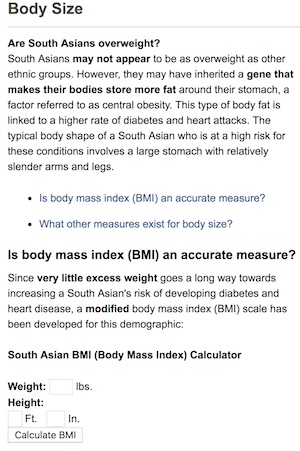
Unless you have been hiding under a rock you know that people of South Asian are at more risk for metabolic disease than is the norm. More concretely we tend toward “skinny fat.”

My current BMI 24. By normal calculators I’m normal weight (barely), because the cut-off is 25. But for South Asian we should be worried if we’re above 23.

There is the caveat that muscle is heavier, so one shouldn’t take BMI literally, as opposed to seriously. You know if you have too much visceral fat, you don’t need to weight yourself. The phenomenon of brown guys with big bellies due to years of self-indulgence is a thing. And excess weight among South Asians who reach a certain affluence level seems a thing the world over.

So here’s a question: for those of you who have managed to keep the weight off and stay trim, how do you do it? Exercise? Diet? Both?

Is this Islamophobic

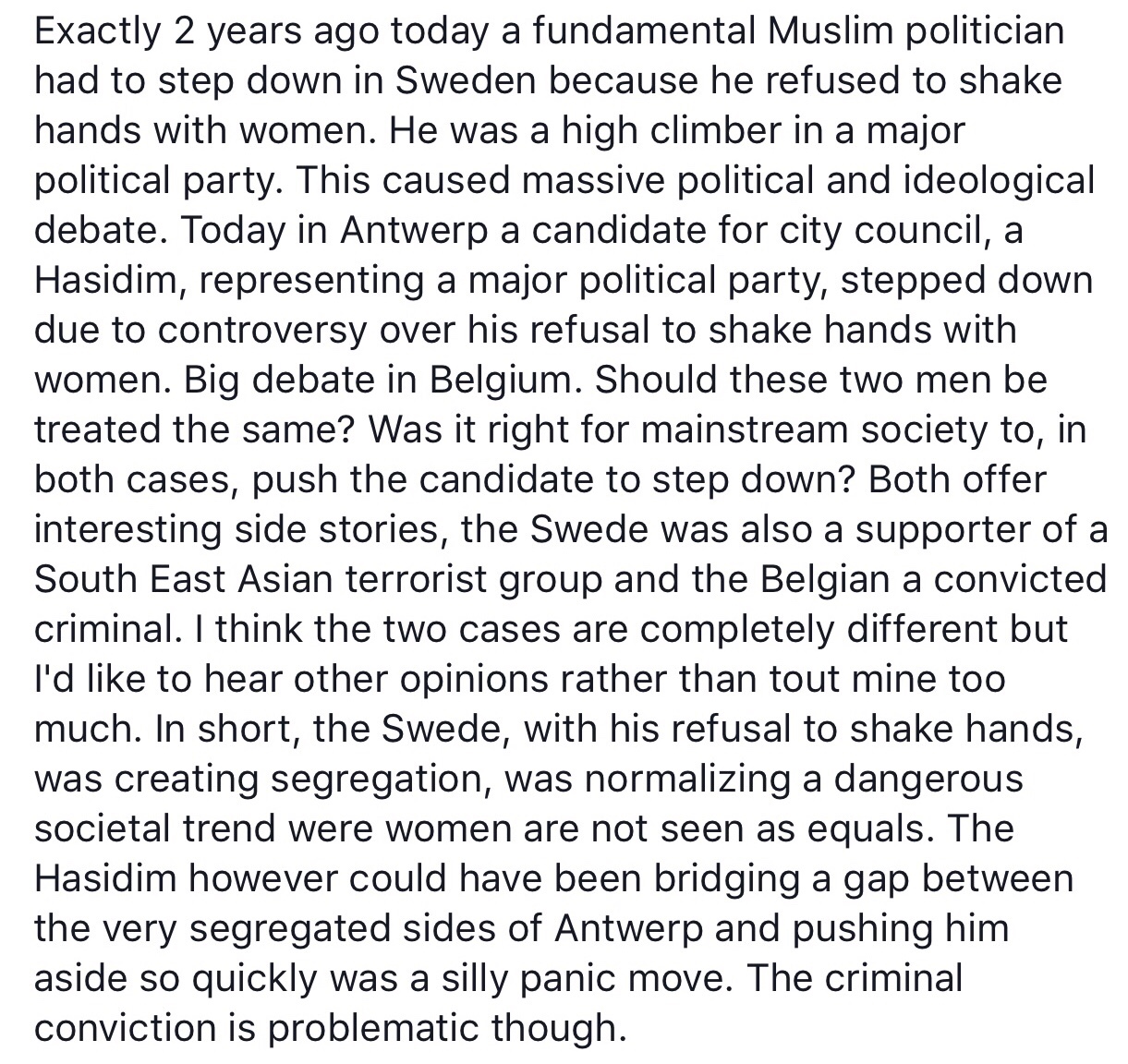
I saw this status on Facebook and it annoyed me (I removed any reference to the author etc).

What’s the difference except if one is Muslim and the other is Jewish; if they refuse to shake hands the same treatment should be meted to both.

Semitised Iran, Aryanised India

There had once been a comment on this blog that the Kashmiris were more Aryan in cultural heritage than the Persians (even if the genetic contribution was the same). At the time I was a bit surprised but in retrospect when I think to modern Persian identity and the Iranian super-strate on top of it (what is Iran; the plateau, the people or the language family?), it’s astonishing to see that most of the influences are Safavid.

When I deconstruct my Persian national identity apart from the Sassanians, Achaemenians and Zoroastrians; it’s really to do with Sa’adi, Ferdowsi and Hafez. The evolution of Persian culture, under the rubric of Islam, has been so complete that as an example even the most hardcore Persian nationalists wouldn’t dare mess with the alphabet.

The Persian language, which is absolutely fundamental to Iranian identity, has wrapped itself around the Arabic alphabet. The pride in the “Aryan racial heritage” is at best correlated with being light skinned etc (in the West lots of Iranians like to bandy about being Aryan to fit in; good for them). However the Aryan heritage doesn’t really figure in a substantial way about what it means to be Persian.

In contract to India where the Aryan heritage is dominant and uninterrupted, constantly tussling with the Arabic-Abrahamic faiths (Islam is equally Arabic as it is Abrahamic; to be a part of the House of Islam is to accept that Arabs are primus inter pares, not exactly equivalent to Brahmins).

Of course Persian is an “Aryan language” but to deny its Semitisation and the glories that the Arabic infusion brought; as well as being the lingua franca (in a literal sense Persians has always had some similarity to France & French culture; is Iran the France of West Asia?) of the Great Gunpowder Empires.

The irony of course is that while Iran is an explicitly Aryan term; India probably is not. While Sindhu is a Sanskrit name for sea, it’s origins are obscure (am to be corrected).

The Conundrum that is Husain Haqqani

I was recently asked by AnAn to write a detailed post about Mr. Hussain Haqqani (henceforth HH) and his three books that I’ve read. I find it difficult to write about someone who is still active in his field of work and someone who arouses so much anger and partisanship among the commentariat in Pakistan. I decided to write about things that I know definitively, publicly available information about him and testimonies from two reliable witnesses about HH and then briefly discuss the three books (Pakistan: Between Mosque and Military, Magnificient Delusions and India vs Pakistan: Why Can’t we just be friends) that I’ve read (I just started reading his fourth one, ‘Reimagining Pakistan’). It is hard to label HH as a turncoat or opportunist because most major politicians in Pakistan changed course in their political life starting with Zulfiqar Bhutto, followed by Mian Nawaz Sharif, Benazir Bhutto(BB) and Imran Khan. People and their ideas evolve or else, they are ossified and become part of history while they are alive (Exhibit A: Most of the left-wing politicians of Pakistan).
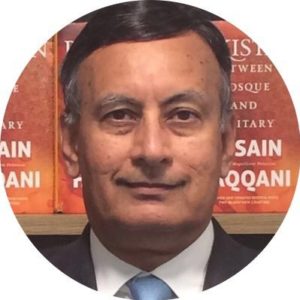
HH comes from a Muhajir family based in Karachi and went to Karachi University where he was an active member of Islami-Jamiat-Tulaba (IJT), the student-wing of right-wing, religio-political party, Jamaat-e-Islami (JI). He claimed in Magnificient Delusions that he stopped students from burning down the American Consulate in Karachi in 1979 when Grand Mosque in Mecca was seized by ultra-Wahabi rebels and the conspiracy theorists put the blame on the US initially (the Embassy in Islamabad was burnt down by a mob of students). His claim has been debunked by several members of IJT at the time. He worked as a journalist for a few years after graduation. In the late 1980s, he was a media-consultant for Nawaz Sharif, the center-right politician from Punjab who rose to prominence as Punjab’s finance minister under General Jilani’s governorship (1980-85) and later served as the Chief Minister of Punjab (1985-90). Nawaz Sharif was part of an Islamist alliance, Islami Jamhoori Ittihad (IJI) which opposed Benazir Bhutto’s Pakistan Peoples Party (PPP) in the 1988 elections. It is beyond doubt that the character of Benazir Bhutto and Nusrat Bhutto was mercilessly attacked during the election campaign. Helicopters were used to throw fliers over major cities in Punjab with explicit photos of the Bhutto ladies to malign their reputations. According to witness number 1, he saw HH in New York during that campaign where HH was offering nudes of Benazir Bhutto to anyone who was interested to see them. IJI still couldn’t win the federal election and ended up winning in Punjab, where Nawaz Sharif assumed the Chief Minister-ship.

Due to Palace intrigues and constant bickering between Punjab and the Federal Government and unrest in Sindh, BB’s government was dismissed by Ghulam Ishaq Khan, the President, after twenty months. In the ensuing elections, IJI succeeded in winning the election (there was massive rigging taken place on orders of the Presidency and funds were distributed to various IJI politicians, details of which can be found by googling ‘Mehran Bank Scandal’). HH served as Sharif’s spokesman till 1992 until he was sent to Sri Lanka as Pakistan’s ambassador. In 1993, the Sharif Government was dismissed by President Khan (with prodding and backroom deals by BB and Co). HH flew back from Sri Lanka and became a spokesman for the BB government that followed (1993-1996).

In 1996, the second BB government was dismissed by President Laghari and Nawaz Sharif’s party started ruling again. It was toppled during October 1999 and General Musharraf became the ‘Chief Executive’ of Pakistan. According to witness number 2, he saw HH begging Musharraf (or one of his generals) for the Information Ministry. The request was denied and HH spent a few years running a consultancy. In 2002, he arrived in Washington DC, as a guest of Carnegie Endowment for International Peace. In 2004, he joined Boston University as an Associate Professor of International Relations. He also headed a project by Hudson Institute on Islam and Democracy. Post-9/11 was a time in which the issue of Islam and Democracy was selling quite well in the ‘West’.
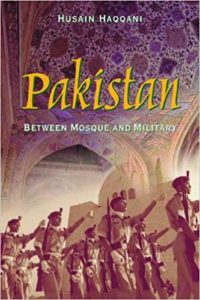
In January 2005, ‘Pakistan: Between Mosque and Military’ was published. It is a very good book detailing the history of Pakistan and the Mullah-Military Nexus that rules Pakistan today. The book was written with the help of Carnegie Endowment and the audience in mind was definitely American (with emphasis on post 9/11 understanding of Pakistan). It touches on all the relevant bases (quoting Ayesha Jalal, Khalid bin Sayeed, Margret Bourke-White, Stephen Cohen, Lawrence Ziring), the way Islam was used by Muslim League (and in certain instances, Jinnah himself) during the ‘Pakistan Movement’, the paranoia induced by newspapers and politicians about threats to Pakistan’s existence, the trifecta of Pakistan Ideology (Islam, Urdu, hostility towards India), suppression of dissent by ethnic groups using the tools of the Ideology (branding anti-state elements as anti-Islam is favored strategy even today), the way history was shaped from an anti-British perspective to an anti-Hindu perspective (since we got Independence from the British, not the Hindus), the first Kashmir War, the first Martial Law, attempts at a revisionist historiography, the disaster that was the 1965 war with India and so on. The book reveals very little new information (if you have read the liberal-secular version of Pakistan’s history) but is a very good collection of various liberal-secular  and diplomatic sources and serves as a good primer on Pakistan’s political history. I’ve always maintained that HH’s writing is often much better than his politics or his past.
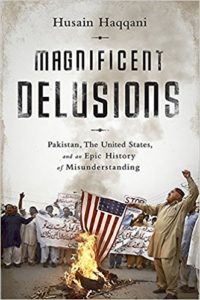
It is often said that Pakistan’s political landscape is dominated by 3 A’s (Allah, Army, and America). The discussion on US-Pakistan relations in the first book forms the basis of his second book, Magnificent Delusions. Four years ago, I wrote a couple of articles, titled ‘Good Ally, Bad Enemy?’ reviewing US-Pakistan relations with excerpts from HH’s second book alongside the works of Carlotta Gall, Gary Bass and Daniel Markey (1. here 2. here). I’ll mention some quotes from HH’s book that I used in those articles.

“Anti-western propaganda was often unleashed precisely so Pakistani officials could argue that the United States had to support Pakistan against India, so as to preserve its alliance with them. Few Pakistanis knew how much their country and its armed forces had become dependent on US assistance.”

‘James L. Langley, American Ambassador to Pakistan (1957-59) wrote, “Pakistan’s forces are unnecessarily large for dealing with any Afghan threat over Pashtunistan. Pakistan would be of little use to us should perchance worse come to worst and India go communist… One of the most disturbing attitudes I have encountered in the highest political places here is that the United States must keep up and increase its aid to Pakistan, and conversely, that Pakistan is doing the United States a favor in accepting aid, in addition to the Pakistani pro-Western posture in the Baghdad Pact and SEATO and the United Nations, when actually these postures are in part dictated by Pakistani hatred for India.”

“India’s Prime Minister at the time, Indira Gandhi, ‘tried to persuade [Henry] Kissinger to recognize the need for more robust US involvement. She said that Pakistan has felt all these years that it will get support from the United States no matter what it does, and this has encouraged an “adventurous policy.” India is not remotely desirous of territory, and to have the Pakistanis base the whole survival of their country on hostility to India was irritating.”

“When Zia was approached by an American diplomat who conveyed the anxiety on America’s part regarding Pakistan’s nuclear weapons development, Zia said: ‘I am an honorable man. We are an honorable people. I ask you to tell your President that I give him my word of honor as President of Pakistan and as a soldier, that I am not and will not develop a nuclear device or weapon.'”
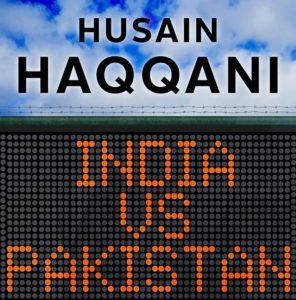
In his third book, HH focussed on certain aspects of the thorny India-Pakistan relationship: History, Kashmir, Nuclear Bombs, and Terrorism. The book is peppered with anecdotes and is a useful read as a primer on the relationship and the difficulties therin. One gets the impression after reading the book that if it were left to the civilians, the two countries would have patched out most conflicts, however, Pakistan’s military and India’s diplomatic bureacracy took maximalist positions to thwart that ambition time and time again.

Why is HH so controversial in Pakistan now?

He was appointed Pakistan’s Ambassador to the US by the PPP-led government (2008-13). It was a turbulent time for Pakistan because barbarians were literally at the gates (Taliban in Swat and Al-Qaeda+TTP in Waziristan). HH has certain views about Pakistan that are not palatable for the military establishment/Deep State. Those views include his insistence on civilian supremacy in the country, deceptive attitudes towards the United States and over-reliance on religion in political discourse. In addition, HH was trying to be a conduit between Pakistan’s civilian government and the United States during his time as the Ambassador (as opposed to a majority of Pakistani Ambassadors to the US who are appointed only after a firm nod from the GHQ) and that irked the establishment even further. It was during his tenure that Osama bin Laden was found and killed in Abbotabad (May, 2011). HH, in an op-ed published last year in Washington Post (read here), took credit for helping the Obama administration in that endeavor (which, in light of Trump’s recent ascension to power, seemed an opportunistic move). Soon after the raid, a conspiracy theory was hatched by the Military Establishment in Pakistan implicating HH. It was alleged that HH had sent Admiral Mike Mullen a memo (on President Asif Zardari’s advice) through a shady in-between named Mansoor Ijaz asking for help from the US in case our generals tried to topple the government in the wake of the OBL raid. The case dragged on in the court and later, a judicial commission but the charge was not proven. HH had to resign as the Ambassador. He has since been at Hudson Institute. In recent years, he has started, with the help of another Pakistani-American, Dr. Mohammad Taqi, SAATH forum (South Asians Against Terrorism and Hatred) that gathers progressive voices in London every October to talk about the future of Pakistan. (Full disclosure: I have been invited to the last two versions of this forum but the first one i couldn’t attend because of visa refusal and the second because I was doing an internship in Houston at the time). I personally agree with most of his views regarding Pakistan but I think his name has been tarnished so much by the Deep State that it is hard to advocate for his name/ideas/books in Pakistan. I believe that he is worth-reading and worth-engaging. If only the military establishment could fight ideas with ideas instead of slander and mis-information.

P.S I have highlighted two events mentioned in the article that were based on stories shared with me by two people I have known for a while. HH presented his own version of events in two tweets last night (05/22/19). Here’s what he tweeted:

The piece contains some ‘I saw X do Y’ without cross-chekcing and is not accurate because of that.  (https://twitter.com/husainhaqqani/status/1131390153400958977)

For example, witness no 1 claims he met in NY during 1988 election campaign. Browsing through my passports (all preserved since 1974) would reveal that I was never in US during that period. people lie for all sorts of reasons. That’s why corss-checking is so important. (https://twitter.com/husainhaqqani/status/1131391145546801159)

Witness 2’s claims suggest that he was present in meetings between Musharraf and I or between one of Musharraf’s minitsers and I. Again, should have been easy to verify veracity or lack thereof with a little effort. (https://twitter.com/husainhaqqani/status/1131395539835207680)



Brown Pundits